2006 Presidents' Forum of Southeast Asia and Taiwan Universities
| Introduction | Participants | Programs | Conclusion | Photos |
Time: November 4 ~ 5, 2006
Venue: National Cheng Kung University, Tainan, Taiwan
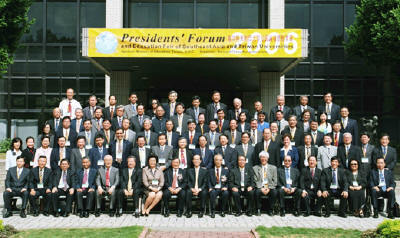
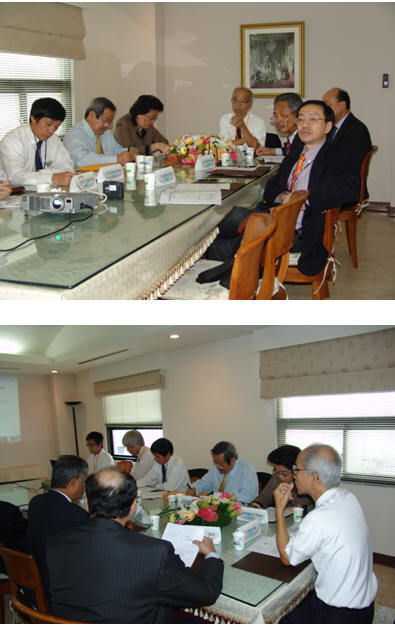
In order to provide a venue for leaders of prominent universities of Southeast Asia and Taiwan to share their opinions and experiences in improving the quality of higher education and academic cooperation in the region, National Cheng Kung University conducted the 2006 "Presidents' Forum of Southeast Asia and Taiwan Universities" (SATU Presidents' Forum) on November 4th and 5th at its campus. As a total, there were 32 universities of six Southeast Asian countries and 70 Taiwan universities attending the Forum. Together, the participants signed a "Consensus on Collaboration in Globalized Higher Education," laying a solid foundation for the future partnership among participating universities.
According to the consensus achieved by the Steering Committee in its annual meeting, two activities, "SATU Summit on Industry-Academia Collaboration" and "Business Plan Competition," will be co-organized by Mahidol University and National Cheng Kung University in 2007 at Mahidol University, Bangkok, Thailand before or right after the Ramadan. All member universities of the Forum will be invited to participate in these two activities.
Furthermore, three major subjects, "University's Functions," "University Quality Assurance" and "University Operational Efficiency," were keenly discussed during the sessions and many inspiring thoughts were unfolded and exchanged among participants.
| University | Participant |
| Indonesia | |
| Airlangga University | Rector Dr. Puruhito |
| Bogor Agricultural University | Rector Dr. Ahmad Ansori Mattjik |
| Diponegoro University | Rector Dr. Ir. H. Eko Budihardjo, M.Sc. |
| Institut Teknologi Bandung | Rector Dr. Djoko Santoso |
| Trisakti University | Secretary of University Senate Prof . A. Prayitno |
| University of Indonesia | Rector Dr. Usman Chatib Warsa |
| Universitas Padjadjaran | Vice Rector Dr. Usman Hardi |
| Malaysia | |
| University of Malaya | Vice Chancellor Datuk Rafiah Salim |
| Universiti Putra Malaysia | Vice Chancellor Dr. Nik Mustapha R. Abdullah |
| Universiti Sains Malaysia | Deputy Vice Chancellor Dato’ Prof . Muhammad Idiris Saleh |
| Universiti Utara Malaysia | Deputy Vice Chancellor Dr. Abdul Razak Chik |
| The Philippines | |
| Ateneo de Manila University | Vice President Dr. Antonette Palma-Angeles |
| CentroEscolar University | President Dr. Ma Cristina D. Padolina |
| De La Salle University-Manila | Vice President Dr. Julius Maridable |
| Far Eastern University | President Dr. Lydia B. Echauz |
| University of the East | President Dr. Ester A. Garcia |
| University of thePhilippines | President Dr. Emerlinda R. Roman |
| University of Santo Tomas | Rector Fr. Ernesto M. Arceo, O.P. |
| Singapore | |
| Nanyang Technological University | Acting Provost Dr. Er Meng Hwa |
| National University of Singapore | Vice President Dr. Lawrence Loh |
| Thailand | |
| Asian Institute of Technology | President Prof . Said Irandoust |
| Assumption University | President Rev. Dr. Bancha Saenghiran |
| Chulalongkorn University | Vice President Dr. Werasak Udomkichdecha |
| KhonKaen University | Assoc. Prof . Dr. Wanida Kanarkard |
| Mahidol University | President Dr. Pornchai Matangkasombut |
| Prince of Songkla University | Vice President Dr. Chatchai Ratanachai |
| Rangsit University | Dean Seree Wangpaichitr |
| Vietnam | |
| Foreign Trade University | Vice Rector Dr. Nguyen Thi Quy |
| Hanoi University of Technology | Vice Rector Dr. Ha Duyen Tu |
| University of Economics, Ho Chi Minh City | Vice Rector Dr. Nguyen Quoc Te |
| VietnamNational University, Hanoi | Vice President Dr. Mai Trong Nhuan |
| VietnamNational University, Ho Chi Minh City | Vice President Dr. Huynh Thanh Dat |
| Taiwan | |
| Asia University | Director Prof . Keh-Ming Lu |
| ChangGung University | President Dr. Chia Chu Pao |
| ChangJungChristianUniversity | President Dr. Chin-Seng Chen |
| Chaoyang University of Technology | Vice President Dr. Yew-Min Tzeng |
| ChengShiu University | Vice President Cheng-Yi Wu |
| ChiaNan University of Pharmacy & Science | President Dr. Chao-Hsiung Wang |
| ChinaMedical University | President Dr. Jong-Tsun Huang |
| ChineseCulture University | President Dr. Tian-Ren Lee |
| Ching-Kuo Institute of Management and Health | President Dr. Chun-Yu Chen |
| Chung ShanMedical University | President Dr. Jia-Yuh Chen |
| Chung YuanChristianUniversity | Acting President Dr. Chien-Song Chyang |
| Da-Yeh University | Acting President Dr. Cho-Chung Liang |
| Far East University | President Dr. Yen-Zen Wang |
| Fooyin University | Vice President Kurtis Koli Chang |
| Fortune Institute of Technology | President Dr. Li-Jung Cheng |
| HsuanChuang University | President Dr. Ruey-Gwo Chung |
| I-Shou University | President Dr. Shen-Li Fu |
| Jin Wen Institute of Technology | President Dr. Yung-Fu Cheng |
| KaohsiungMedical University | President Dr. Hsin-Su Yu |
| KunShan University | President Dr. Ming-Shing Young |
| Leader University | President Dr. Fu-Yih Shih |
| LingTungUniversity | President Dr. Michael.J.K. Chen |
| Lunghwa University of Science and Technology | President Dr. Wen-Fang Yen |
| Meiho Institute of Technology | President Dr. Shan-Da Liu |
| Mingchi University of Technology | President Dr. Thu-Hua Liu |
| Mingdao University | Director Nigel Nai-Chien Shih |
| Minghsin University of Science and Technology | President Dr. Shih-Ming Lin |
| Nan Kai Institute of Technology | President Dr. Kuo-Ming Wang |
| National Central University | President Dr. Lou-Chuang Lee |
| National Changhua University of Education | President Dr. Huey-Por Chang |
| National ChengKung University | President Dr. Chiang Kao |
| National ChiNan University | President Dr. Jin-Fu Chang |
| National Chiayi University | President Dr. President Dr. Ming-Jen Lee |
| National Chung Cheng University | President Dr. President Dr. Ren C. Luo |
| National Chung Hsing University | President Dr. Jei-Fu Shaw |
| National College of Physical Education and Sports | President Dr. Hung-Shih Chou |
| National DongHwa University | President Dr. Wen-Shu Hwang |
| National Formosa University | President Dr. J.D. Lin |
| National KaohsiungHospitality College | President Dr. Chi-Yeh Yung |
| National Kinmen Institute of Technology | President Dr. Chin-Cheng Lee |
| National Penghu University | President Dr. Huei-Jeng Lin |
| National Pingtung University of Science and Technology |
President Dr. Yuan-Kuang Guu |
| National SunYat-Sen University | President Dr. Chung -cheng Chang |
| National TaiChung Nursing College | President Dr. Shieu-Ming Chou |
| National Taipei College of Nursing | President Dr. Ue-Lin Chung |
| National Taipei University | President Dr. Chung -Wen Hou |
| National Taipei University of Technology | President Dr. Tsu-Tian Lee |
| National Taitung University | President Dr. Chorng-Jee Guo |
| National Taiwan Ocean University | President Dr. Kuo-Tien Lee |
| National Taiwan University | Vice President Dr. Tai-Jen George Chen |
| National Taiwan University of Science and Technology | President Dr. Shi-Shuenn Chen |
| National Tsing Hua University | President Dr. Wen-Tsuen Chen |
| National United University | President Dr. Lung-Sheng Lee |
| National University of Kaohsiung | President Dr. Ing-Chung Huang |
| National Yunlin University of Science and Technology | President Dr. Tsong-Ming Lin |
| Providence University | President Dr. Matthew Min-Teh Yu |
| ShihChien University | President Dr. Samuel K.C. Chang |
| Soochow University | President Dr. Chao-Shiuan Liu |
| Southern Taiwan University of Technology | President Dr. Hsin-Hsiung Chang |
| Ta Hwa Institute of Technology | President Dr. Wen-Chou Chen |
| Tajen University | President Dr. Shan-Hwei Ou |
| Tatung University | President Dr. Jiann-kuo Wu |
| Technology and Science Institute of Northern Taiwan | President Dr. Hsin-Chung Lien |
| The Overseas Chinese Institute of Technology | President Dr. Yuan-Shi Peng |
| Tunghai University | President Dr. Haydn H.D. Chen |
| Tung Nan Institute of Technology | President Dr. Wen-Shien Chou |
| TzuChi University | Vice President Dr. Fwu-Mei Chang |
| Tzu Hui Insitute of Technology | Principal Dr. Chorng-Chih Huang |
| WenzaoUrsuline College of Languages | President Dr. Wen-Ray Lee |
| Yuan Ze University | President Dr. Tsong P. Perng |

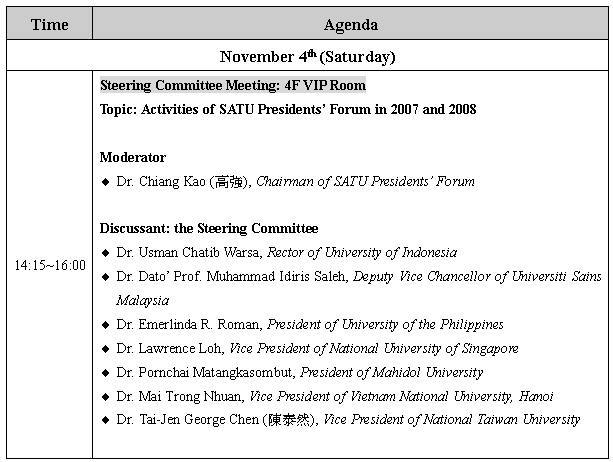


A. Steering Committee Meeting
Two activities, “SATU Summit on Industry-Academia Collaboration” and “Business Plan Competition,” will be co-organized by Mahidol University and National Cheng Kung University in 2007 at Mahidol University, Bangkok, Thailand before or right after the Ramadan. All member universities of the Forum will be invited to participate in these two activities. Furthermore, the business plan competition will be held as a two-round contest. The first round will be conducted by the Steering Committee member universities at the domestic level. The results will then be submitted to the Secretariat for the final contest. Whereas the host universities will support their local transportation and accommodation after they arrive at Bangkok, the competitors need to take care of their own international transportation. The rules and schedule of the competition in detail will be announced to SATU member universities afterwards.
Regarding the workshop, executive leaders of successful multinational companies in Taiwan and Southeast Asia will be invited to share their experiences on how to run a business in foreign countries and how to make it successful by cooperating with the local academic institutions.
B. Panel Discussions
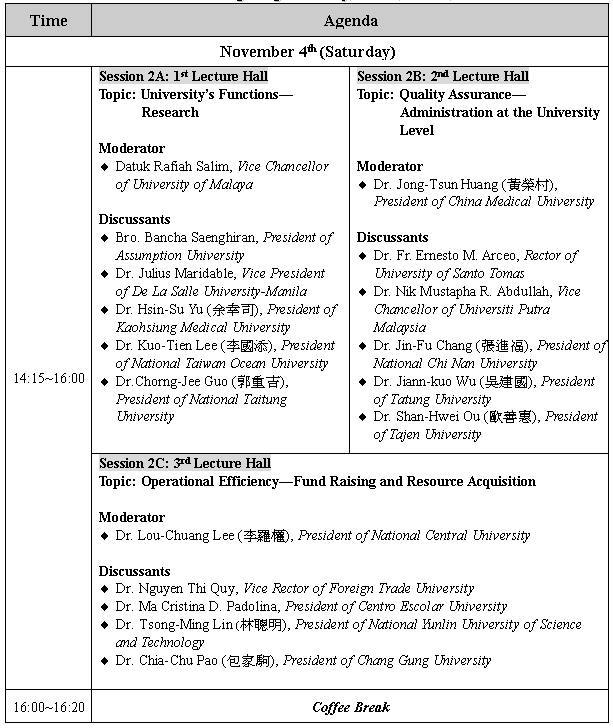
Topic 1: University's Functions
(A) Research
First, it is agreed that the three main functions of the university are teaching and learning, conducting research, and providing service to the public. In other words, the primary purposes of the university are the dissemination of knowledge and of the advancement of its academic achievements.
Second, to make the research a strong culture of a university, the idea must be embedded in the mission and the visionary statements of the university.
Moreover, the university's function of research should be integrated with its function of teaching. One cannot teach well if one does not do further research at the same time. Even in a university, whose reputation has been built on the lecturing, doing research is also very important for keeping its competitiveness. Thus, teaching cannot be separated from research, and vice versa. As operating these two functions at the same time, universities become reservoirs and generators of knowledge for the good of human kind.
On the other hand, since research is a very expensive activity and since the major funding of many universities of the region come from their government, how far can a university reach in the mentioned field depends on its own nation's aspiration as well as the nation's status of development. Whether the country sees the research as a national priority or to which level could the homeland stand for it decides its future. Besides, for the private schools, there is another problem to be solved. The shortage of financial support from the government makes it more difficult for them to obtain enough resources for advancement.
Certainly, the research institutions and individuals always need to look for outside investment on their own. However, raising fund should not be the primary objective of the researchers. On the contrary, achieving key performance indicators in related fields, acquiring recognition from the society, attaining partnership with outstanding industries and accumulating public awareness on proper policies and moral issues should be the major concerns of universities on the way to becoming excellent teaching and research centers.
(B) Education
The University education is an advanced process of knowledge accumulation which should comply with the needs and expectations of individuals, the society and the nation. For individuals, the university education helps them in building up their skills and in cultivating their philosophical mind for self-formation and continued learning. For the society, education helps to establish its cultural presence, to pursuit contribution to human society and to the community development. For the nation, education fosters and nurtures its future elites and leaders. It creates a think tank for making public policies. Nowadays, however, the worth of university education is challenged by the question of employability of its graduates.
The global society is growing ever more complex, requiring greater skill and knowledge from its citizens. Also, the college graduates now face increasing competitions not only from their fellow countrymen but also from the ambitious, intelligent young people around the world, who are eager to climb to whatever skilled works that can be digitized and outsourced from distance around the globe. Therefore, the content of higher education must be able to meet the students' requirements of multiple employment opportunities and to fulfill the request of various potential employers in the job market.
(C) Internationalization
As the world moves toward a global village, internationalization has become one of the important factors of the university's functions. The trend and need will grow stronger in the future.
English, as an international language, is one of the most important means for communication. Unfortunately, courses in English are not widely provided in the universities in Taiwan, nor in Southeast Asia. As a matter of fact, learning Chinese becomes an advantage for universities in Taiwan to attract international students, especially at the undergraduate level. Yet the trend of Taiwanese students going abroad for higher education is much stronger than international students coming to study in Taiwan. The devotion and contribution in academic area from those who went abroad for advanced learning help to upgrade the level of domestic academy. However, as fewer and fewer students in Taiwan want to go abroad for graduate studies nowadays, universities cannot rely on this source of scholars any more in the near future. As a result, internationalization becomes a more urgent issue in the future.
In addition, many effective means and mechanism are mentioned to develop the internationalization at universities. The knowledge museum program, double-degree programs, exchange programs, etc., should be of help to the development of the mentioned process. The purpose of building a globalized environment is to provide students the opportunities to acquire international experiences and knowledge, to pay attention on international affairs, and then to be benefited by understanding different kinds of cultures and backgrounds of students worldwide. Faculties can also get advantages by exchanging new research and teaching methods with the visiting scholars. That will create a win-win situation.
To sum up, financing programs mentioned above could be a huge burden for many universities. Nevertheless, the government and universities should work together and find ways to break through the limitation.
Topic 2: University Quality Assurance
(A) Administration at university level
Administration is a driving force for academic achievement and quality assurance. To improve administration at the university level in order to enhance quality assurance, there are notions such as ISO 9001, Total Quality Management (TOM) and overall quality assurance administration to be followed. The assurance process focuses not only on the quality of the procedure but also on the quality of the content.
Quality assurance procedure can further be decomposed as internal and external components. Discussants believe that these quality assurance procedure and concerns are becoming more standardized, and many universities are advised to follow the request as much as possible. It might not be proper to force all classes of universities to do so by deciding how much money they will be given. However, without controlling the financial power it is impossible to boost all the universities to follow the trend. Even under this conviction, policy implementation should still be very careful in order not to transform the universities into pure commercial entities that will drive them to compete ruthlessly in the so-called free market.
For the benefit of quality assurance in administration at the university level, two principles are recommended. First, set mission statement and conduct internationally or based on cross-university comparison. After this, the university will have a firm stand to lead. Cross national standard as benchmark tossed ahead, the strategy plans that followed will be kept right on the track. Moreover, Key Performance Index (KPI) could also be promoted during the progress.
The second principle falls on the psychological aspect. Effectiveness means to do the right things, while efficiency means to do things right. A well-managed university needs to combine both qualities at the same time. As many psychological analysts will admit, people tend to do things right when they are happy. Therefore, a crucial step of quality assurance is to help the university faculty and students to develop their commitments to their organization so that they will regard themselves as an inseparable part of the university and will see the exuberance of the university as their future common good.
(B) Faculty evaluation
In general, there are three components in faculty evaluation, that is, teaching, research and service. The consultation and guidance to students can be included in the last part. It is not necessary to put emphasis on this order. The ranking of these three components actually depends on the policy and mission of each university. Furthermore, the emphasis will also vary from school to school, and even from department to department. The outcome of the evaluation will then result in salary difference.
The evaluation of academic ranking and tenure also differ from country to country. Some follow the national guideline, while the others follow the individual university rules. In some countries, faculties in the public universities are considered as civil servants and are submitted to civil service structure, which is not suitable for top universities. However, whether there should be a national guideline for professorship is still open for further debates.
(C) Incentives for research
Dr. Werasak of Chulalongkorn University explained their respective programs including quality assurance program and strategy. Provision for the research program both internally and externally, grants for young scholars, awards for international publications, support for participation in international conferences and declaration for productive units as the center of excellence were suggested.
Dr. Santoso of Institut Teknologi Bandung indicated a framework showing the interrelationship between the quality assurance and research incentives. He made very strong statement on defining the relationship between the research productivity and research incentives. These statements include: 1. incentives for research should be consider as a catalyst to develop research culture in the university; 2. incentive for research should be treated as a counterpart to generate research fund; and 3. quality assurance in research will increase the quality and quantity of university research.
Dr. Shaw of National Chung Hsing University talked about the ingredients for success in research and the one that enabled the environment for research, which includes: (1) atmosphere for intellective excitement; (2) academic freedom to foster intellective activities; (3) substantial and consistent financial support from the government, private sectors and industrial-academic collaboration; (4) increased structures both in hardware and software; (5) efficient administration to support the research; (6) dedicated and distinguished faculties; (7) award and recognition in research; (8) encouragement in interdisciplinary research; and (9) existence of functional research supporting units.
Dr. Luo of National Chung Cheng University focused on the research performance of Taiwan, and how it will help to improve the international competitiveness of Taiwan. He highlighted the ranking of Taiwan in terms of inventions. Also, he talked about the advantages of academic-industrial collaboration, which decrease the cost of research and development, enabling the university to share industry skills with market sense, lessening disputes in intellectual property rights and facilitating fully use of university resources.
Topic 3: University Operational Efficiency
(A) Fund raising and resource acquisition
In the past ten years, budgets from government support to universities have decreased, but the tuition can only be raised to a certain level because of students' protest and the social pressure. Hence, how universities well use their limited budget is an important issue.
In Vietnam, some universities try to seek for research grants from international agencies or development agencies like World Bank or European Commission to solve financial problems and to sustain tuitions for international students. In the Philippines in 1997, the government set up an educational act that allowed universities to establish trust fund and join business. Although the missions of the university are education, research and service, the production has become another objective for many universities.
In Taiwan, some universities seek funding from smaller companies. A common way of universities to show appreciations to the sponsors is to bestow them an honorary degree or the right to name the facilities they help to build; both encouraged the donation.
However, the tax law in Taiwan or other Asian countries does not encourage endowments from the industry. On the contrary, the tax credit in the Philippines is up to 150%. Therefore, the increase of tax donation credit may be a way to ease the problems faced by Taiwan universities.
Another way to acquire financial resources is to set up centers of excellence, which will attract more funds from the government as well as from some private organizations.
(B) University autonomy
In the old days, maintaining the university autonomy was not a problem. However, recently universities have served too many purposes and carry too much responsibility in areas of education, research and social service. Therefore, the administrations of universities begin to have difficulties to meet the expenses for all the costs. Also, the stress of international competition forces universities to open their doors in order to catch up with the changing of global environment and to update themselves with the modern technology.
Nowadays, for keeping the autonomy, universities should have cooperate-style functions, including institutional management, consistent vision on the university goal, promotions and awards based on merits and productivity, centralization on decision making, rapidly response to technological change, etc. Also, universities could provide courses sharing expenses with other institutions, conduct income generating activities or invest on profit-oriented commercial ventures.
Furthermore, since the university is still equipped with qualities of teaching and research, its decision-making process should be transparent and the results should be open to the public.
(C) Academia-industry collaboration
The session discussed two issues: (1) Whether the educational policy of a university is stable or not? (2) Why to promote the academia-industry collaboration? The reasons range from seeking for funding to enhancing the competitiveness of the university, from enabling students' capability in problem solving to cultivating leaders of the next generation. Moreover, it is believed that if the educational policy changes frequently, it will be difficult for universities to continue their partnership with the industry.
To accomplish the goal, each university needs to reexamine its resource condition, including the humane resources, the financial situation and even the political position. After defining the roles and then adjusting their goals and strategies to it, universities can therefore select the most suitable industrial-academic collaboration programs.
As many people might agree, the 19th century is the British century and the 20th is of the Americans. But for the 21st century, it will be an era of Asia. The European and American experiences can serve as a mirror for the Asians to learn from their success and at the same time to avoid making the same mistakes. One of the advantages in industrial-academic collaboration is to provide opportunities for our professors and students the ability to solve problems and to observe new knowledge, especially in the cases of international collaborations. Moreover, a platform for information sharing with effective management and professional analysis is also required.
However, the recent cases of academia-industry collaboration can hardly meet the needs of university education. There is a large gap between theoretical and practical requirements. Universities should establish friendship and mutual trust with the industry in order to meet the short-term requests from the industry and the long-term educational purposes for themselves.
Also, when young faculties are involved in the projects of academia-industry collaboration, they nevertheless have to sacrifice their time on teaching and doing research. That is the dilemma that almost every university faculty would face.
To conclude, academia-industry collaboration does not only mean to provide extra income for the universities but also to fulfill the educational mission of universities and to create the largest benefits for their students. Therefore, how to increase the value of academia-industry collaboration should be the universities' future tasks.
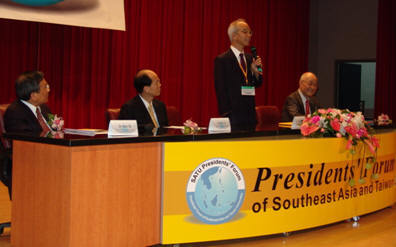
President of National Cheng Kung University
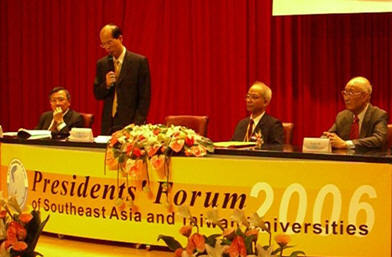
Deputy Minister of Education, Taiwan, R.O.C.

Deputy Minister of National Science Council, Taiwan, R.O.C.
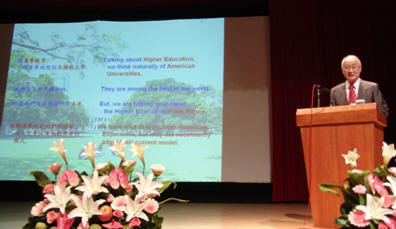
Dr. Jin Wu, Member of Academia Sinica and Former Minister of Education, Taiwan, R.O.C.

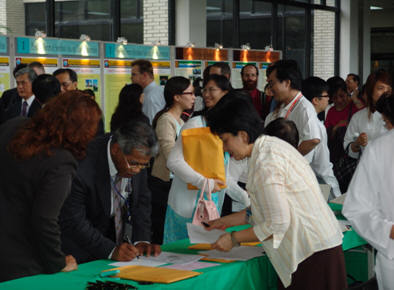



Dr. Morris Chang, Chairman of Taiwan Semiconductor Manufacturing Company

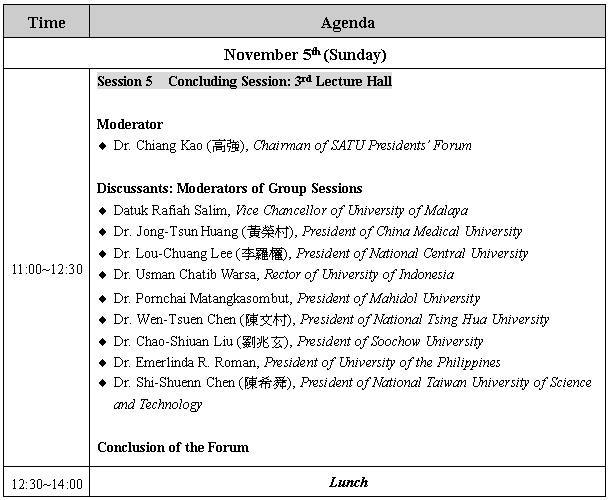
Concluding Session
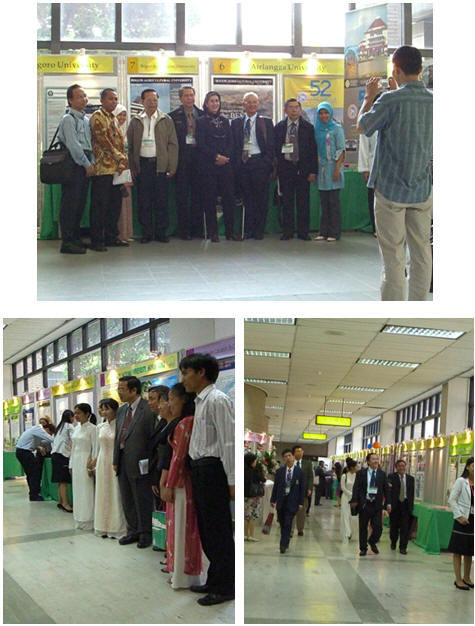
Forum Ambassadors: international students currently studying at NCKU
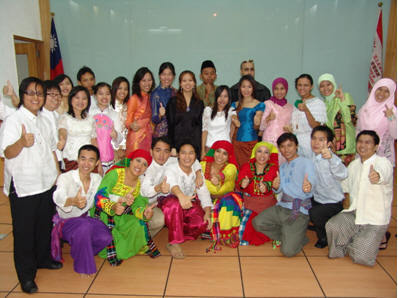
Above: at the press conference
Below: at the Forum venue

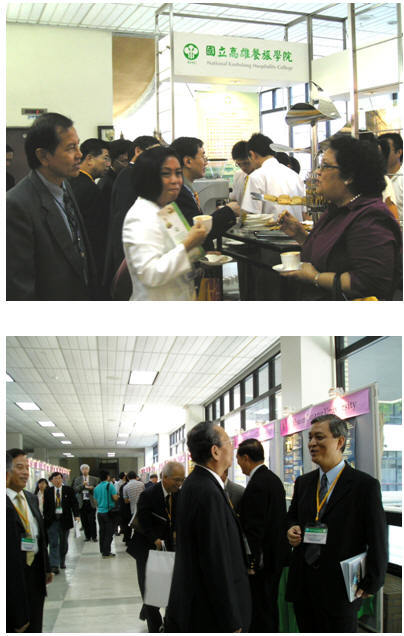
Southeast Asia and Taiwan Education Fair
Tour
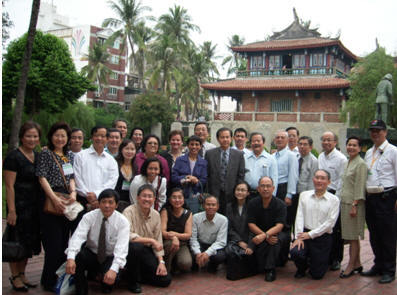
Chihkan Tower, Tainan City

Sun Moon Lake National Scenic Area Administration, Tourism Burean
Nantou County
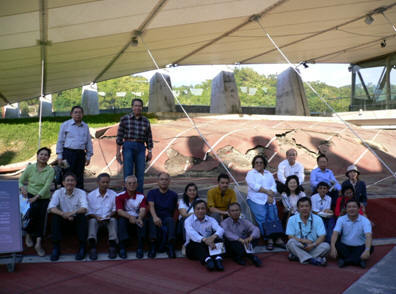
921 Earthquake Museum of Taiwan, Taichung
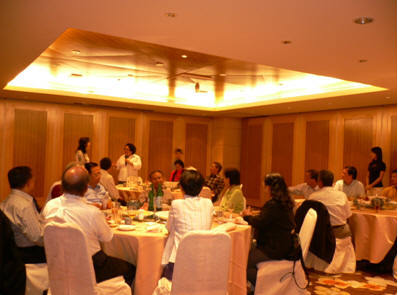
Farewell Dinner: Datuk Rafiah Salim (standing, right), Vice Chancellor of University of Malaya,
expresses her appreciation to NCKU staff on behalf of the participants